
Working from home sounds dreamy until you’re actually in it — juggling client deadlines, kids running around, dishes in the sink, and a laptop that keeps migrating from the kitchen table to the couch.
Most new freelance writers don’t realize how much their environment impacts their focus, confidence, and output.

A good workspace doesn’t have to be Instagram-worthy. It just needs to help you show up and write.
Here’s how to set up a freelance workspace that supports your brain, your workflow, and your business.
1. Pick a Spot That Helps You Actually Sit Down and Write

Your workspace doesn’t need to be a full office. It just needs to be consistent.
When I first started freelancing back in 2014, I wrote on a tiny laptop at the end of my dining table during nap times.
That was my spot. My brain knew: sit here → write.
A few ideas that work well:
- A corner of your bedroom
- A dining table spot that’s always yours
- A desk squeezed between two bookshelves
- A small table near a window
- A rolling cart setup you can pull out during work sessions
Consistency matters more than aesthetics.
2. Keep Only the Things You Reach for Every Day
Productivity goes up when your brain isn’t scanning clutter.
A crowded desk makes it harder to settle in and actually write, so I keep only the things I use every single day within reach.
For me, that usually means my laptop on its stand, my notebook, a couple of pens, my content calendar, and my water bottle with a lid because kids seem to have a sixth sense for open cups.
When I’m deep in client work, I’ll add printed briefs for multi-post projects so I don’t have to dig through tabs or folders every five minutes, but even then I keep the surface clear enough that my mind stays calm.
Everything else gets put away — not because I’m naturally organized, but because I write better when my space isn’t competing for attention.
I learned this early on when I used to work at the end of the dining table during nap time.
The less I saw, the more I got done.
So now I stick to a simple rule: if I haven’t touched something in a week, it doesn’t get to live on my desk.
It keeps the space focused, predictable, and easy to slide into whenever I’m switching between client work and my own content.
3. Light Matters — More Than You Think

When there’s natural light it can boost focus and reduces that “I’m dragging myself through molasses” feeling.
For years I worked at a desk with my back to a window.
When I finally turned it so I could see outside, my productivity shot up.
Now I always choose a spot near a window if I can.
If natural light is limited:
- Use a warm LED task lamp
- Avoid overhead lights that feel harsh
- Try a small ring light if you film content between writing tasks
You’re going to spend hours here — make it easy on your brain.
4. Reduce Digital Clutter the Same Way You Reduce Physical Clutter
Most freelancers spend more time fighting tabs than fighting distractions from kids.
It’s incredible how fast your focus slips when you’ve got twenty windows open and half of them are unrelated to the project you’re supposed to be writing.
I’ve found that keeping only two or three tabs open at once makes a huge difference.
Anything more than that and my brain starts wandering.
I also use a completely separate browser profile for client work so I’m not tempted to peek at LinkedIn, YouTube, or my own content tasks.
Even something as small as an open email tab can derail my flow, so I keep it closed unless I’m intentionally checking it.
What helped the most, though, was creating simple, dedicated folders in Google Drive for each client.
Once I separated client spaces from my own content universe, everything became easier to find and easier to focus on.
My mind stopped jumping lanes, and the work sessions became calmer, cleaner, and much more productive.
5. Use Small Boundaries (They Work Better Than Big Ones)

You don’t need to close your office door to work.
What you need are cues that tell your brain it’s time to work.
Little boundaries go further than people realize.
When I sit down, I turn on my small desk lamp, put my phone in another room, have my water bottle handy, and grab my noise-canceling earbuds.
I also have a specific playlist I use only for deep writing sessions, and sometimes I’ll light a candle that I reserve just for work hours.
These tiny rituals signal a shift and it helps romanticize my work day.
They create a mental transition that helps me drop into focus faster — which is especially important when you’re a mom writing during nap time, right after school drop-off, or late at night when the house finally settles down.
It doesn’t take much.
Just a few consistent cues that remind your brain, “This is writing time.”
6. Make It Comfortable, But Not Too Comfortable
I wrote one of my highest-earning articles sitting on the couch with my laptop balanced on a pillow.
My back wasn’t thrilled, and neither were my shoulders the next morning.
Comfort matters if you want to write consistently for years, not just days.
These days, I keep things ergonomic.
A laptop stand makes typing easier on my neck, and using an external keyboard and mouse keeps my posture in check.
I also adjust my chair so my shoulders aren’t creeping up toward my ears, and if a chair feels too firm, I’ll add a cushion so I’m not shifting around every five minutes.
But here’s the trick: don’t make your workspace too cozy.
There’s a balance.
A comfortable setup keeps you from burning out physically, but too much comfort and your energy drops fast.
A little structure helps you stay alert and engaged, which means better writing and fewer mid-sentence naps.
7. Keep Distractions Out of Your Line of Sight

If I face the kitchen, I suddenly notice the dishes.
If I face the laundry basket, now I’m thinking about folding towels. It’s amazing how fast your brain jumps to chores the second they’re in your line of sight.
I’ve learned to turn my desk so I’m looking at something neutral or calming.
A blank wall works surprisingly well because there’s nothing for my attention to chase.
A window is even better on days when the light helps me stay focused.
Sometimes I’ll set a small plant in front of me, or hang a simple corkboard with my monthly goals so the only thing I’m reminded of is the work I’m here to do.
What you see absolutely influences how long you stay put.
The fewer visual distractions your workspace gives you, the easier it is to stay grounded in the writing task right in front of you.
8. Add One Thing That Makes You Want to Sit Down and Write
Productivity improves when your environment feels welcoming.
For me, it’s:
- A small pink plant pot
- Soft lighting
- A mug warmer (game changer if you’re a slow coffee drinker)
For you, it might be:
- A framed quote
- A vision board
- A candle
- A cozy throw blanket
Make your workspace feel like a place you enjoy, not a place you dread.
9. Create a “Reset Routine” for the End of Each Work Block
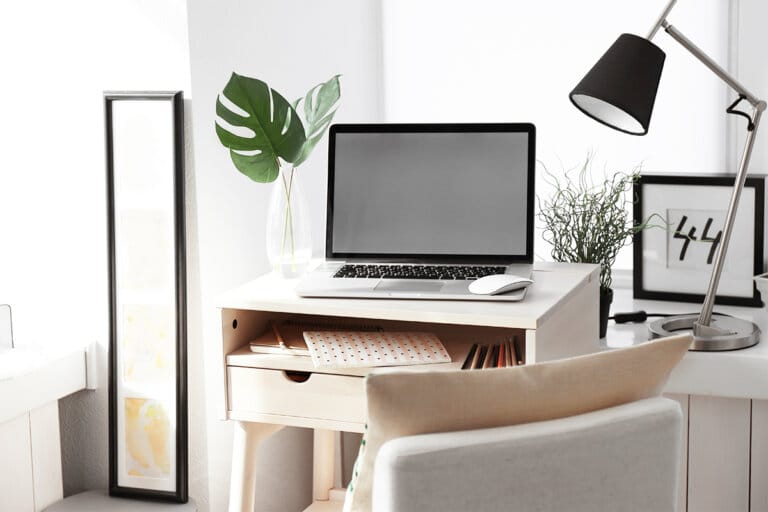
This takes about sixty seconds and makes your next writing session ten times easier.
At the end of every work block,
I close my tabs, put my notebook away, and toss any scraps or sticky notes I’ve scribbled on.
I straighten my chair and quickly set up the first task I’ll tackle tomorrow so I’m not sitting down to a mystery or a mess.
It sounds small, but this tiny reset keeps me from feeling overwhelmed the moment I open my laptop again. Instead of wasting time warming up or figuring out where I left off, I can jump right in.
It’s a simple habit that keeps my space — and my mind — clear.
Final Takeaway: A Productive Workspace Doesn’t Require a Renovation
You don’t need a Pinterest-perfect home office to be a productive freelance writer.
You need a spot that’s consistent, uncluttered, and cues your brain that it’s time to write.
Your environment can either drain your energy or support it.
Set it up intentionally, and you’ll feel the difference in your confidence, your output, and your client results.



Leave a Reply